

Part 1
Watch the lesson
The lesson introduces the most important uses, time expressions and verb forms. The readable transcript follows directly underneath.
Lesson transcript
Introduction
In the next two lessons we’re looking at verb tenses for the present, and we’re going to concentrate on the Present Simple and the Present Continuous.
Each lesson is divided into three parts. Part 1 gives example situations. Part 2 looks at verb forms: positive, question and negative. Part 3 contains practice exercises.
Let’s start with the Present Simple. Examples include I go, we play and he eats.
Part 1: When we use the Present Simple
There are two main types of situation to remember.
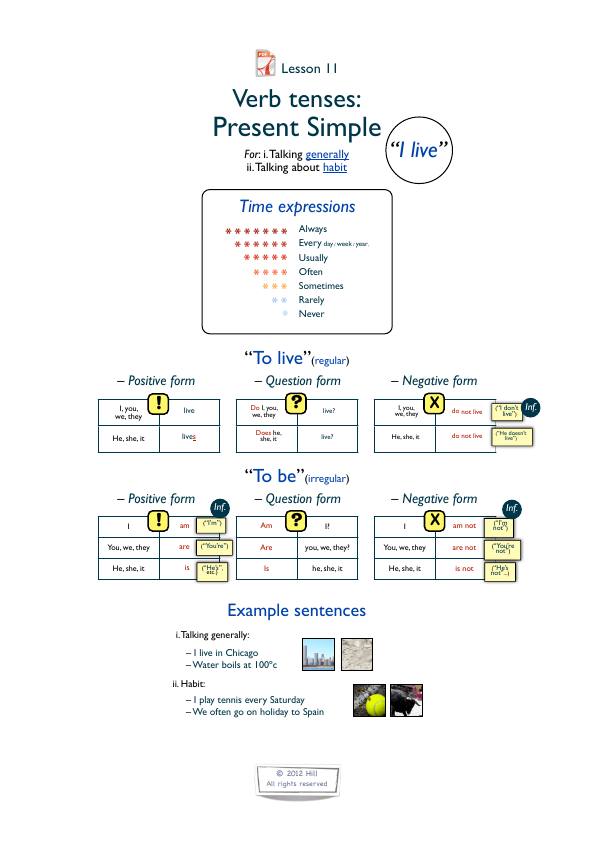
First, we use the Present Simple for talking generally.
- I live in Chicago.
- I am from Chicago.
- Water boils at 100 degrees.
Second, we use the Present Simple for habits.
- I play tennis every Saturday.
- We often go on holiday to Spain.
Notice that both habit sentences contain time expressions: every Saturday and often. Time expressions are important when learning tenses because they make it easier to remember which tense to use.
Useful time expressions
The following expressions are especially useful for talking about habits. The frequency words move from most frequent to least frequent.
We also commonly use expressions such as every day, every week, every year and every Saturday.
So far we’ve seen that we use the Present Simple for talking generally—I live in Chicago—and for habits—I play tennis every Saturday.
Part 2: The verb “to live”
We’ll use to live as an example of a regular verb. Pay special attention to the -s in the third person singular.
| Subject | Positive | Question | Negative |
|---|---|---|---|
| I / you / we / they | live | Do … live? | do not live / don’t live |
| he / she / it | lives | Does … live? | does not live / doesn’t live |
The verb “to be”
To be is irregular, so its forms are different from other Present Simple verbs.
| Subject | Positive | Question | Negative |
|---|---|---|---|
| I | am / I’m | Am I? | am not / I’m not |
| you / we / they | are / you’re / we’re / they’re | Are …? | are not / aren’t |
| he / she / it | is / he’s / she’s / it’s | Is …? | is not / isn’t |
Next: practise
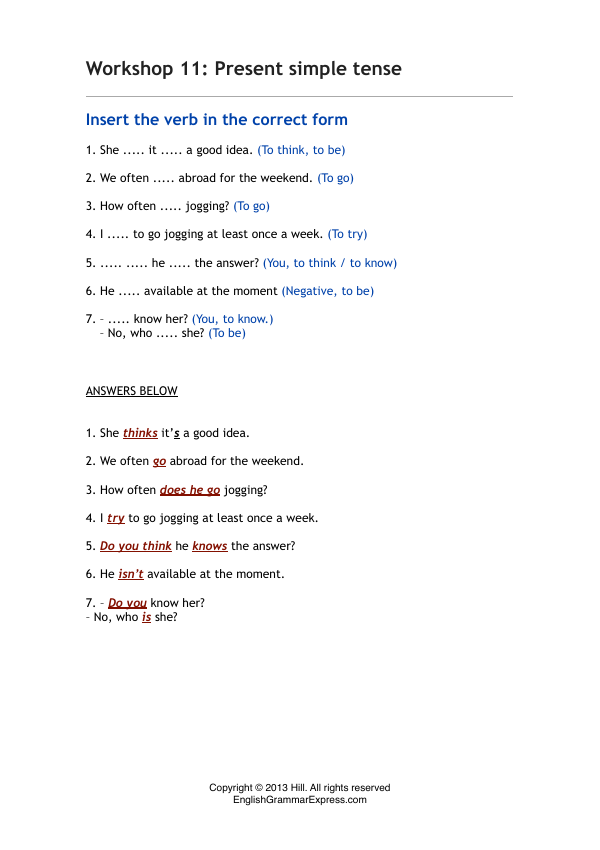
Use the revision handout to review the time expressions, the forms of to live and to be, and the example sentences. Then continue to the video exercise below.
Part 3
Try the video exercise
Pause when you need more thinking time. Say or write your answer before the explanation appears.