

Part 1
Watch the lesson
The lesson explains the two main uses of the Present Continuous, its most helpful time expressions and the positive, question and negative forms. The readable transcript follows directly underneath.
Lesson transcript
Introduction
In this lesson we’re looking at the Present Continuous. Examples include I’m staying, it’s raining and we’re eating.
We make the Present Continuous with the correct form of to be plus the main verb ending in -ing. We’ll begin with example situations, then look at positive, question and negative forms, and finally continue to the practice exercise.
Part 1: Precisely now
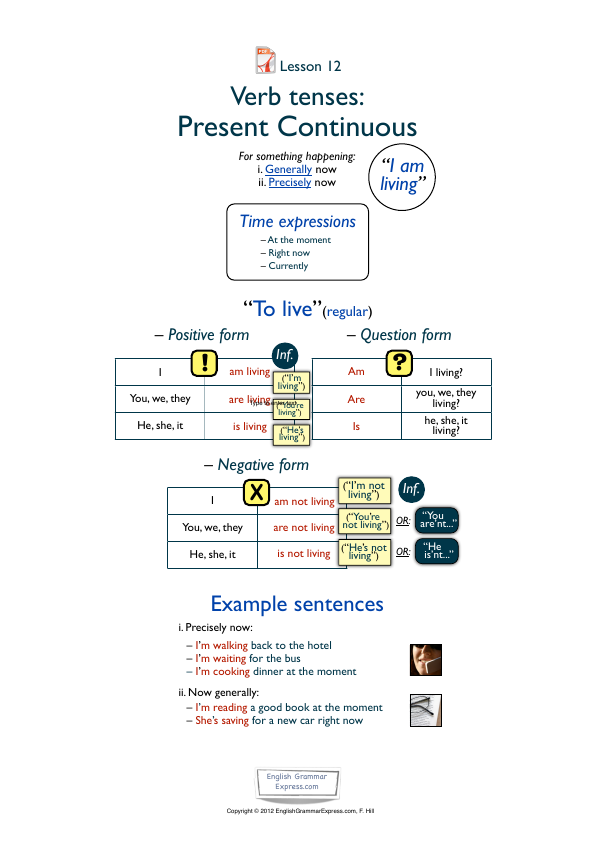
We use the Present Continuous for an action that is happening at this precise moment. Imagine somebody speaking on the phone and describing what they are doing:
- I’m walking back to the hotel.
- I’m waiting for the bus.
- I’m cooking dinner at the moment.
In all three examples, the action is happening precisely now.
Generally now
We also use the Present Continuous for an action or situation happening generally around the present, even when it is not taking place at this exact second.
- I’m reading a good book at the moment.
- She’s saving for a new car right now.
- I’m living in London currently.
The reading, saving and living are current activities or situations, but they do not have to be happening at the precise moment of speaking.
Useful time expressions
The most useful Present Continuous time expressions in this lesson are:
- at the moment
- right now
- currently, which is slightly more formal
All three expressions can describe something happening precisely now or something happening generally around the present.
Part 2: The verb “to live”
We’ll use to live to show the positive, question and negative forms.
| Subject | Positive | Question | Negative |
|---|---|---|---|
| I | am living / I’m living | Am I living? | am not living / I’m not living |
| you / we / they | are living / you’re, we’re, they’re living | Are … living? | are not living / aren’t living |
| he / she / it | is living / he’s, she’s, it’s living | Is … living? | is not living / isn’t living |
It is worth learning the verb forms and the time expressions until you can remember them quickly in conversation.
Next: practise
Use the revision handout to review the two uses, the time expressions, the forms of to live and the example sentences. Then continue to the video exercise below.
Part 3
Try the video exercise
Use the situations and time clues to practise the Present Continuous and decide whether each action is happening precisely now or generally around the present. Pause when you need more thinking time, and say or write your answer before the explanation appears.