

Part 1
Watch the lesson
The lesson introduces finished past actions, useful time expressions and the main verb forms. The readable transcript follows directly underneath.
Lesson transcript
Introduction
In this part of the course we’re looking at three important tenses connected with the past: the Past Simple, the Past Continuous and the Present Perfect.
Each lesson is divided into three parts. Part 1 gives example situations. Part 2 looks at verb forms: positive, question and negative. Part 3 contains practice exercises.
Let’s start with the Past Simple. Examples include I arrived, she asked and they lived. With regular verbs, we normally make the Past Simple by adding -ed.
Irregular verbs do not follow this pattern, so the course also includes a separate lesson on irregular forms.
Part 1: When we use the Past Simple
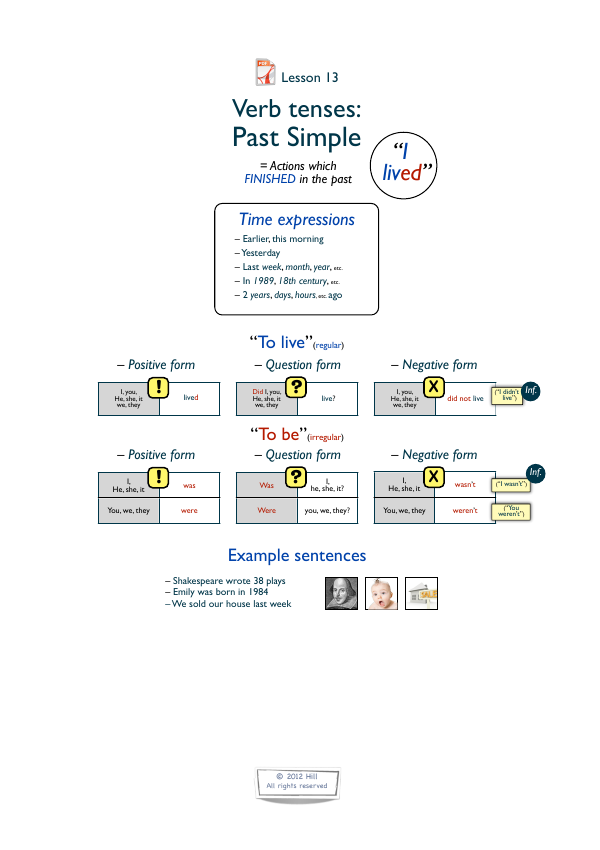
We use the Past Simple for actions and events that finished in the past.
- Shakespeare wrote 38 plays.
- Emily was born in 1984.
- We sold our house last week.
The actions in all three examples are finished. Notice that wrote, was and sold are irregular Past Simple forms.
Useful time expressions
Time expressions can help you recognise when the Past Simple is the right tense. Common examples include:
- earlier or this morning
- yesterday
- last week, last month or last year
- in 1989 or in the 18th century
- two years, two days or two hours ago
Even today can refer to finished time when, for example, you speak in the evening about something that happened in the morning.
Part 2: The verb “to live”
We’ll use to live as an example of a regular verb. The positive form is the same for every subject.
| Subject | Positive | Question | Negative |
|---|---|---|---|
| I / you / he / she / it / we / they | lived | Did … live? | did not live / didn’t live |
The verb “to be”
To be is irregular, so its forms are different from other Past Simple verbs.
| Subject | Positive | Question | Negative |
|---|---|---|---|
| I / he / she / it | was | Was …? | was not / wasn’t |
| you / we / they | were | Were …? | were not / weren’t |
Next: practise
Use the revision handout to review the time expressions, the forms of to live and to be, and the example sentences. Then continue to the video exercise below.
Part 3
Try the video exercise
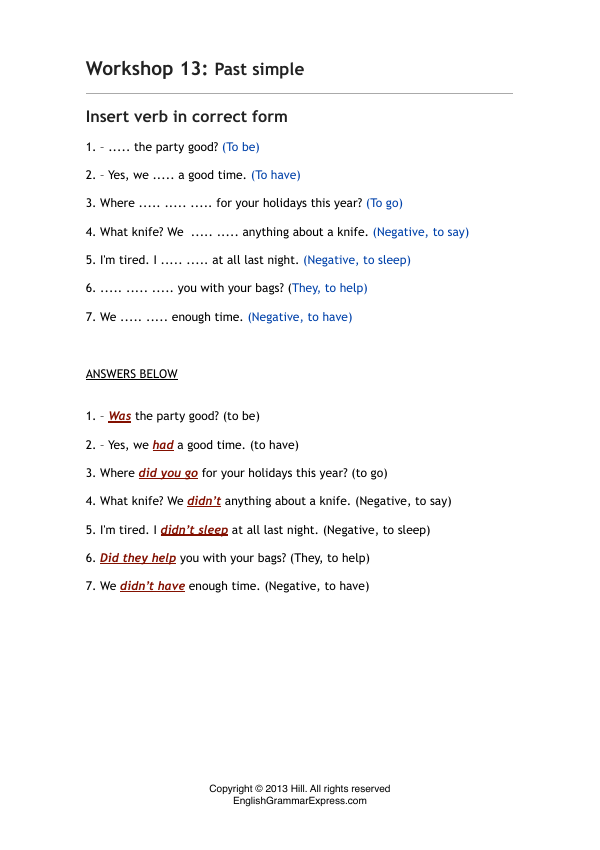
Use the visual clues to practise positive, negative and question forms. Pause when you need more thinking time, and say or write your answer before the explanation appears.