

Part 1
Watch the lesson
The lesson focuses on three main situations for will and then builds the positive, question and negative forms.
Lesson transcript
Introduction
Hi, in the next two lessons we're looking at future tenses.
So, in this lesson we'll look at Future Simple tense, and in the lesson after we'll look at verb tenses for Future Plans.
So let's get started with Future Simple tense.
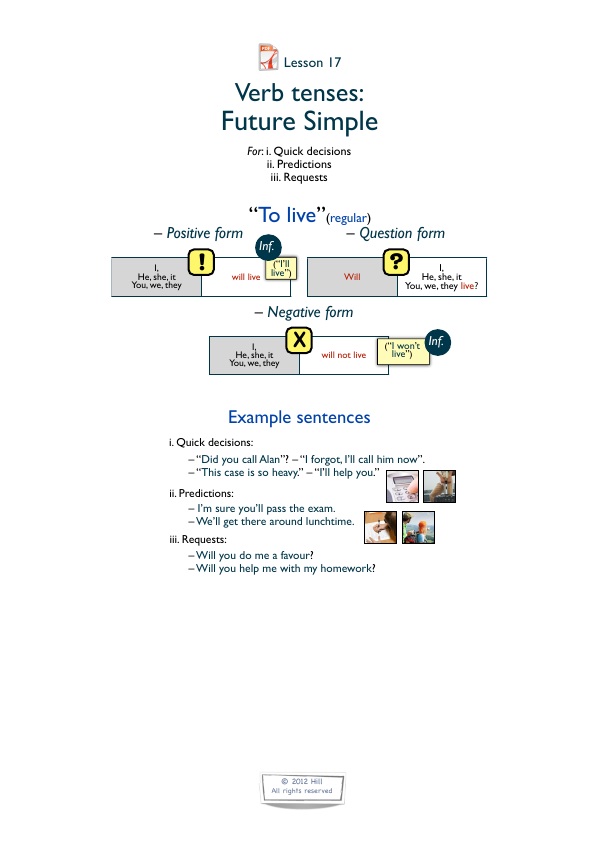
We make Future Simple with 'will' plus the infinitive verb.
So, for example 'I will ask', 'we will tell him'. And in the question form: 'will he come out?'
In this lesson, I want to talk about three main situations for 'will'.
The first situation in which we use will is for quick decisions.
The example here is 'Did you call Alan?'
Response: 'I forgot, I ___ him now.'
Well, let's look for the verb, first of all. And the verb we want is 'call' in the future simple form. The answer is 'I'll call him now. The full version is 'I will call him now' which is more formal.
In normal conversation we would simply say 'I'll call'.
The most important thing to remember here is that when I say 'I'll call him', I've made a quick decision.
Example 2 for quick decisions:
'This suitcase is so heavy. I ___ you.'
Well, the verb we want is 'help' and so the answer here is 'I'll help you' or 'I will help you' if you want.
The third example is:
'Don't worry I ___ these'
The answer is 'Okay then, I ___ lunch'.
Well, the verb we want I suppose could be 'buy' but we are in a bar and it's a slightly more informal expression that we want – so a better verb here would be 'get'. In which case the full sentence is:
'Don't worry, I'll get these'.
We could also say 'I'll pay for these'.
The responding sentence is: 'Okay then I'll get lunch'. And again, we could say 'I'll pay for lunch'.
Notice here that this is also a promise to do something later. We could also have: 'I'll do it tomorrow', 'we'll go next year'.
So that's 'will' used for quick decisions.
The second main way in which we use 'will' is for predictions.
Three more examples here. The first is: 'I'm sure you ___ the exam'.
Well, the verb here we want is 'pass', so 'I'm sure you'll pass the exam' is the answer.
Notice that like all predictions this is an opinion about the future. So, to emphasise the opinion aspect we're saying here 'I'm sure'.
Other expressions would be 'I think you'll pass' or 'I expect you'll pass the exam' – all predictions for the future form 'will'.
Second example is 'We ___ there around lunchtime'.
Well, she is predicting an arrival so we could say 'We will arrive there around lunchtime'.
More conversational is 'we'll get there around lunchtime'.
Just like the last example, to emphasise the opinion aspect, she could say 'I'm sure' or 'I expect we'll get there around lunchtime'
And, to add some uncertainty she could also say 'We'll probably get there around lunchtime'. 'Probably' is fine with 'will'.
The third example for predictions with 'will' is 'they say ___ sunny tomorrow'.
Here we're talking about the weather and the verb we want is 'be'.
So they say 'It'll be sunny tomorrow', and again, to add some uncertainty we could say they say 'It'll probably be sunny tomorrow'.
So that's 'will' for predictions.
The third way in which we use 'will' is for requests. The usual form is to say 'will you' plus the verb.
The examples are: 'Will you do me a favour?'
Another example would be: 'Will you help me with my homework?'
And another example would be: 'Will you play a song for us?'
So again, it's 'will you' plus the verb, to 'help' and 'play'.
If you want to be more polite you could add 'please' to the end of each sentence and replace 'will' with 'would' you or even 'could' you to be even more polite.
So – 'could you do me a favour please' is very polite.
So those are the three main uses of 'will', which are quick decisions, predictions and requests.
Let's now move into verb conjugations for 'will'.
I'm going to concentrate on the verb 'to live' in the positive, question and negative forms.
Starting with the positive form with 'to live'– future simple.
– I / you / he / she / it / we / they… will live.
And, as we've seen already for conversational English we would say:
–'I'll live' or 'you'll live', 'he'll live'.
And so the question form now:
– ___ I / you / we / he / she / it ___?
The answer is 'Will I / you / he live'.
This is the same in the formal or informal use.
And finally in the negative form:
– I / you and so on ___.
The answer is:
– 'I will not live' and, just like in the positive form, we can shorten this to
'I won't live', you / he / she / it / we / they won't live'.
So that's the end of the lesson on future simple. To revise, you can print out this PDF which summarises everything I talked about in this lesson.
You can see we have the main uses here, we have the conjugations here and we have some example sentences at the bottom. Join me in Part 3 for the practice exercises on Future Simple tense.
Part 3
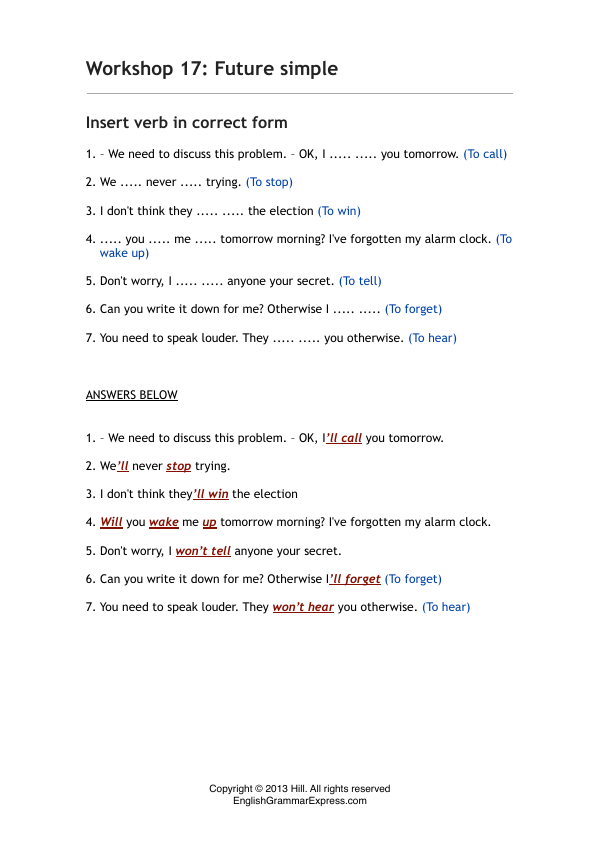
Try the video exercise
Use the video exercise to choose and form will correctly in short future situations.