

Part 1
Watch the lesson
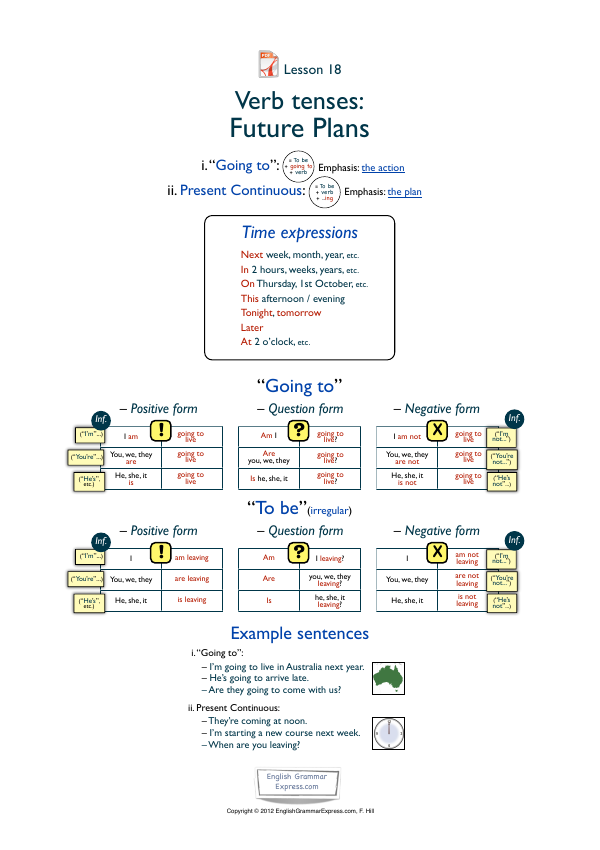
The lesson begins with three future sentences and explains why going to and the Present Continuous normally describe plans more naturally than will.
Lesson transcript
Introduction
Welcome back. In this lesson we're looking at future plans in English and the verb tenses that we use.
We're going to start the lesson by looking at three example sentences. It's your job to find the wrong sentence of the three.
So here are the sentences.
Now, number 1: 'I'm going to visit my aunt next week' – in this case, the construction is 'I'm going to'.
For Number 2 the sentence is: 'I'm visiting my aunt next week'.
In this case the construction is Present Continuous – 'I'm visiting'
Number 3: 'I'll visit my aunt next week'. Here the construction of the tense is Future Simple.
So which sentence is wrong? Well, number 1, which uses 'going to' for future plans is fine.
Number 2, which uses Present Continuous – the plan is next week – is also fine.
That leaves sentence 3: Future Simple: 'I'll visit my aunt next week' as the wrong sentence.
We can't normally use Future Simple for future plans. In fact, this is a common mistake.
I often hear students say for example:
'I'll go on holiday next week'. What they should be saying is 'I'm going to go on holiday next week', or even: 'I'm going on holiday next week' in the Present Continuous.
Remember, Future Simple is normally used for quick decisions about the future, for predictions and for requests in the question form.
Now, before we continue let's look at some time expressions for future plans so that we have some context.
Number 1, and this is ___ week, month, year. And the answer is: 'next'.
Number 2, 'in a month, in two months, in a week, is a future plan, we say we'll do something 'in a month'.
Number 3, here we can have 'on' - so, 'on the 1st October here'.
Number 4, this time expression for future plans, where we have 'afternoon', 'evening' is: 'this'. We can also have 'year' or even 'century'.
Number 5, this is 'tonight', or 'tomorrow'.
The 6th expression for future plans is simply 'later'. And Number 7 is 'at… 2 o'clock' when we're talking about 2 o'clock in the future.
Let's now go back to our tenses for future plans.
And we've seen already that we can use 'Going to' and Present Continuous. Let's look at 'going to' first of all.
And we form 'going to' with 'to be' plus 'going to' plus the verb.
For example, 'He's going to arrive late'.
Another example is, 'I'm / I am going to live in Australia next year.'
The third example is 'Are they going to come with us?' in the question form.
Now, you might be wondering about the use of 'gonna', which is basically 'going to' in a short form.
The first thing to remember is that this is a very informal form.
See screen for rest of lesson
Part 3
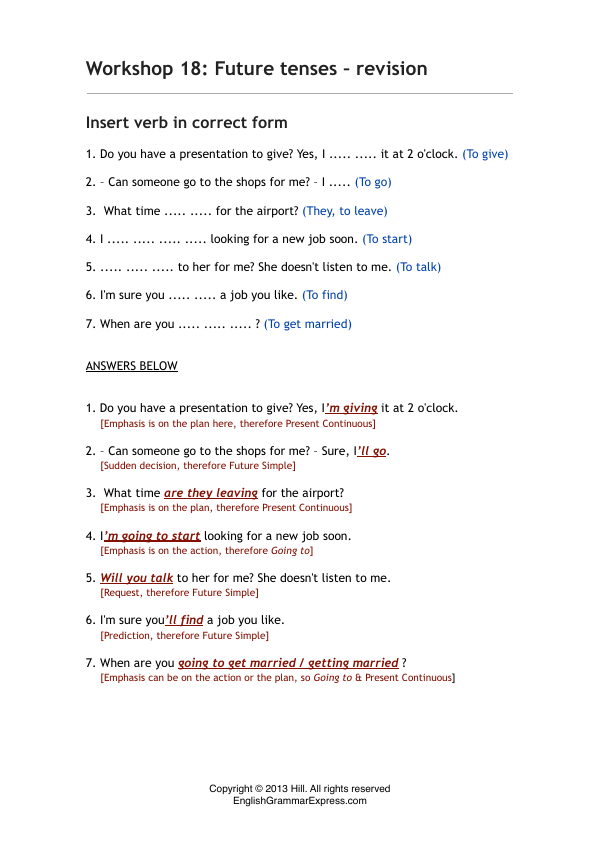
Try the video exercise
Use the video exercise to choose between going to, the Present Continuous and will for different future meanings.