

Part 1
Read the lesson
The lesson works through there is and there are with noun types, questions, negatives and several important tenses.
Lesson transcript
Introduction
In this lesson we're going to look at "there is" and "there are" in 3 different areas.
No. 1: With countables & uncountables,
No. 2: In question and negative sentences, and
No. 3: In different tenses.
So let's start with "there is" and "there are" with countables and uncountables; and we'll begin with a short exercise (which looks like this).
Now, as you can see, there are three sentences, and we have to decide if we use "there is" or "there are".
1. "...a coffee shop on this street".
Do we use "there is" or "there are"?
The answer is "there is". "Coffee shop" is countable singular, for which we use "there is".
2. "...a lot of students in my class".
In this case, we use "there are".
The word "students" is countable plural, for which we use "there are".
3. "...milk in the fridge (UK) / refrigerator (US)"
For this case we would use "there is".
"Milk" is uncountable (singular only).
So let's summarise what we have so far.
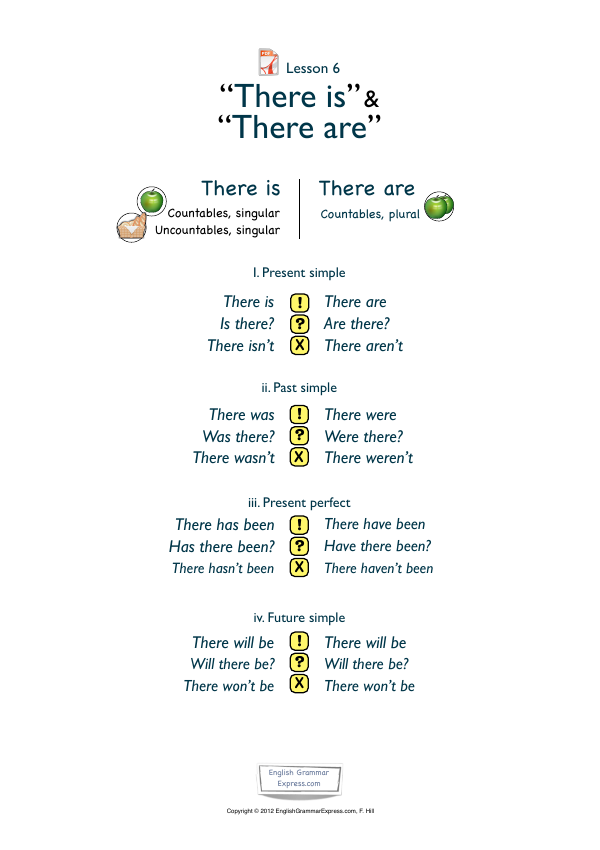
"There is" goes with countables in the singular, so e.g. "there is an apple". It also works with uncountables in the singular, so e.g. "there is bread/some bread".
"There are" goes with countables in the plural, so e.g. "there are apples".
So that's section 1.
Let's now move on to section 2, which is "there is / there are" in positive, question and negative sentences.
So, 'there is' in the Present Simple in the positive is:
– There is. The informal form is 'there’s', which is 'there is' pushed together.
Now in the question we would say:
– Is there? and in the negative we would say:
– There is not.
Again in the informal we would say:
– There's not, or there isn't. So that's 'there is'.
Let's now look at 'there are'.
In the positive, we would say:
– There are.
In the informal we would say:
– 'There're'
In a question we would say:
– Are there?
And in the negative we would say:
– There are not
In the informal we would say:
– There aren't
So let’s practise what we've learned so far by looking at the sentences we saw earlier.
'There's a coffee shop on this street' we saw. Let's turn this into a question.
And to do that, we would say 'Is there a coffee shop on the street?'
'There are a lot of students in my class.'
Let's turn this into a negative and to do that we would say: 'There aren't' or 'there are not' in the formal way 'a lot of students in my class'.
And finally: 'There's milk in the fridge.'
Let's turn this into a question again. And for that we would say:
'Is there milk in the fridge?'
So that's Section 2.
Let's look at the final section now, which is about other tenses.
So far we've seen Present Simple. Next, we're going to look at Past Simple, Present Perfect and Future Simple.
Starting with Past Simple, 'there is' as a positive statement, we would say 'there was'.
In the question, we would say: 'was there', and in the negative we would say: 'there was not'.
In the informal, we would say 'there wasn't'
Now for 'there are' – positive we would say 'there were'.
The question – we would say 'were there?'
And for the negative we would say 'there were not', or in the informal 'there weren’t'.
So that's Past Simple.
Next tense is Present Perfect.
Going back to 'there is' in the positive is: 'there has been'
In the informal, we would say 'there's been', in the question we would say 'has there been?', and in the negative we would say 'there has not been', or informally: 'there's not been' or 'there hasn't been'.
Now 'there are' in the positive is: 'there have been'. In the informal it’s 'there’ve been'. Question is: 'have there been?'
And in the negative it would be 'there have not been' or in the informal 'there've not been' or 'there haven't been'.
So that's Present Perfect.
Let's turn finally to Future Simple with 'there is'. Positive statement: 'there will be'.
In the informal we would say 'there'll be'.
In the question we would say 'will there be?'. And in the negative we would say 'there will not be'. In the informal we would say 'there won't be'.
Finally, 'there are' – and 'there are' is exactly the same in the future simple.
So, to repeat: 'there will be' or 'there'll be' in the question: 'will there be?' and negative 'there will not be' or 'there won't be' in the informal.
So that's the end of Part 1.
Here is the PDF for you to download and as you can see, it has everything that we've looked at in this lesson.
So, countables and uncountables; we have Present Simple here and we have the other three tenses, Past Simple, Present Perfect and Future Simple.
Join me in Part 2 for the practice exercises.
Part 3
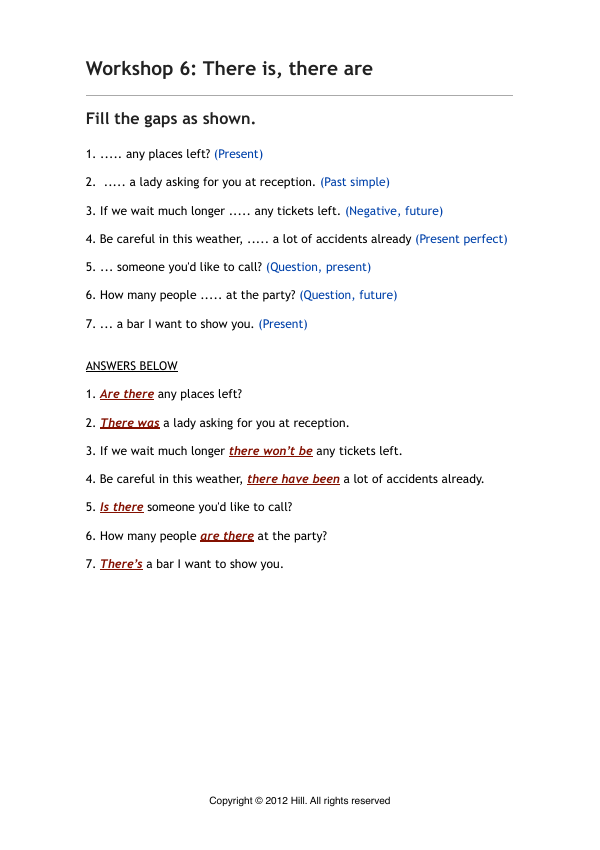
Use the printable practice
Use the printable exercise above to practise singular, plural, question and negative forms.