

Part 1
Watch the lesson
The lesson explains the main uses of the Present Perfect, its most helpful time expressions and the positive, question and negative forms. The readable transcript follows directly underneath.
Lesson transcript
Introduction
In this lesson we’re looking at the Present Perfect. Examples include I’ve arrived, she’s asked and they’ve lived.
The Present Perfect is a very important tense in English, but it can cause confusion. We make it with have or has plus the past participle of the main verb. With a regular verb such as live, the past participle ends in -ed.
Part 1: When we use the Present Perfect
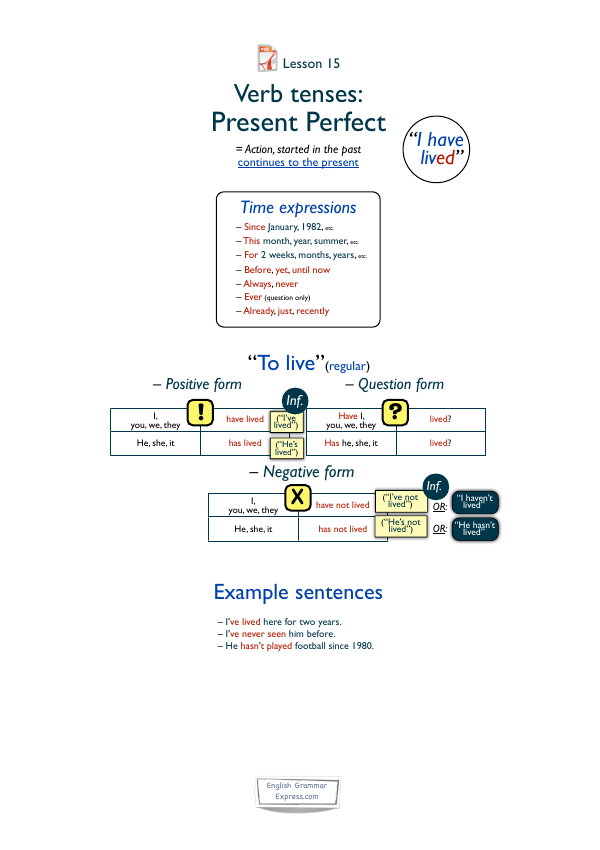
We use the Present Perfect for an action or situation that started in the past and continues to the present.
- I’ve lived here for two years.
- I’ve never seen him before.
- He hasn’t played football since 1980.
In the first example, the two years began in the past and continue up to now. In the second, never before means at no time in my life until now. In the third, the period beginning in 1980 continues until now.
Useful time expressions
These time expressions are often used with the Present Perfect:
- since January 1982
- this month, year, century or summer
- for two weeks, two months or two years
- before, yet and until now
- always and never
- ever, especially in questions: Have you ever been to Portugal?
Yet is normally used in questions and negatives, while ever is commonly used in questions.
Finished actions that are relevant now
We can also use the Present Perfect for a finished action that still matters now. The time expressions already, just and recently are useful for this meaning.
- I’ve just cut my finger.
- Spielberg has recently made a new film.
- I’ve lost my pen.
The finger was cut in the past, but it is relevant now because it is bleeding. The film was made in the past, but it is relevant now because we can watch it. The pen was lost in the past, but the result matters because I still cannot find it.
Time expressions are not always necessary, but learning them makes it easier to choose the right tense in conversation.
Part 2: The verb “to live”
We’ll use the regular verb to live to show the positive, question and negative forms.
| Subject | Positive | Question | Negative |
|---|---|---|---|
| I / you / we / they | have lived / ’ve lived | Have … lived? | have not lived / haven’t lived |
| he / she / it | has lived / ’s lived | Has … lived? | has not lived / hasn’t lived |
Many common verbs have irregular past participles rather than an -ed ending. The next lesson in the original course covers the most important irregular verbs.
Next: practise
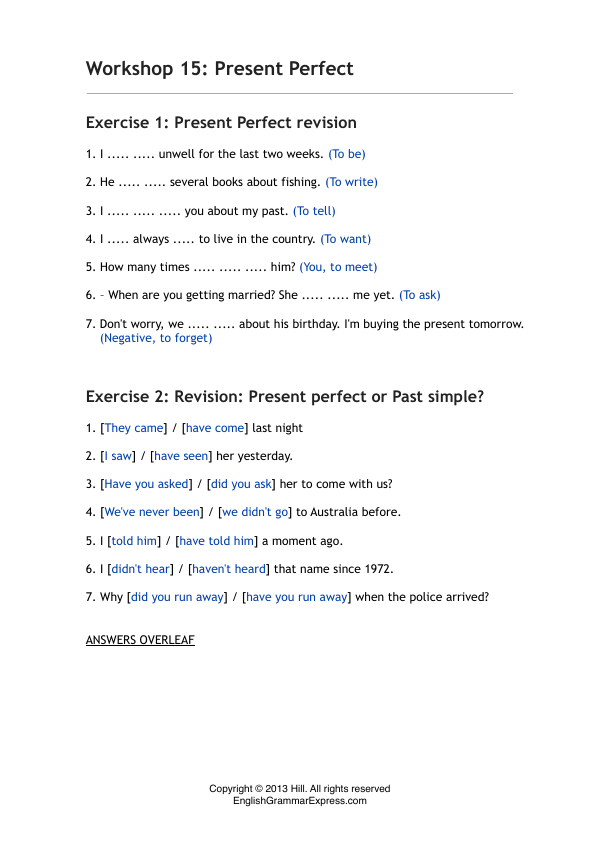
Use the revision handout to review the time expressions, the forms of to live and the example sentences. Then continue to the video exercise below.
Part 3
Try the video exercise
Use the short prompts to practise positive, negative and question forms, along with time expressions such as for, since and ever. Pause when you need more thinking time, and say or write your answer before the explanation appears.