

Part 1
Watch the lesson
The second lesson completes the visual top-fifty list and groups the remaining examples by their prepositions.
Lesson transcript
Introduction
Welcome to the second lesson on phrasal verbs.
In this lesson, we'll finish our top 50 examples and we'll concentrate on phrasal verbs with the following prepositions:
– 'up' – 14 examples,
– 'down' – 6 examples
– 'away' – 5 examples
– 'back' – 3 examples, and
– 'at' – 2 examples.
So let's get started. Number 1, and these are phrasal verbs with 'up' – and there are 14 examples here.
Number (i), this is 'wake up'.
Number (ii), this is 'get up'.
Number (iii), this is 'stand up'. This man is standing up, this man is sitting down.
Number (iv), this is 'pick up'. This boy is picking up a snail.
(v), this is 'clean up' because of this we could also say to 'hoover up'.
Number (vi), this is 'wash up' and
Number (vii), to become older as a child is to 'grow up'.
Next page, number (viii) and to raise a child is to 'bring up'.
You could say 'I was brought up in London'.
Number (ix) and this is to 'tie up'. We can say tie up for shoes or for clothes or whatever.
Another way of saying 'tie up' which is more informal is 'do up'.
Number (x) and this is 'look up'. To 'look up' a word in a dictionary, for example.
Number (xi), this is to 'turn up'. So to turn up the volume on a radio or TV or whatever.
Number (xii), to confuse two things for example, is to 'mix up'.
Number (xiii), this is to 'give up'. So, he's 'giving up' with a white flag.
And number (xiv) to endure, for example something annoying like a loud noise, is to 'put up with'.
So those are phrasal verbs with 'up'.
Let's now look at phrasal verbs with 'down', and there are six examples here.
Number (i) and this is 'break down'. He's broken down on the motorway or whatever.
Number (ii), this is the opposite of 'turn up' – 'turn down'.
Number (iii), this is 'write down'. She's writing down her shopping list by the looks of it.
Number (iv) and this is 'put down'.
Number (v) to become slower is to 'slow down'.
Number (vi), to become calmer is to 'calm down'.
So those are phrasal verbs with 'down'.
Let's now look at phrasal verbs with 'away'. 5 examples here.
Number (i), this is 'put away'. He's putting away some money.
Number (ii), and this is 'run away'.
Number (iii) to go abroad somewhere far for example, is to 'get away' – slightly informal.
We could also say 'go away'. And number (v), to give for nothing is to 'give away'.
So, for example he gave away all of his money to become a monk.
So those are phrasal verbs with 'away'.
Let's now look at phrasal verbs with 'back', and there are 3 examples here.
Number (i) and this is 'call back'. This man is calling someone back.
(ii) and this is 'pay back' and we can also say 'give back' which can be for money or any other object that you're returning.
Number (iii) and to return from somewhere is to 'get back'.
So that's 'back'.
Let's finally look at phrasal verbs with 'at'.
Two examples here. Number (i), this is to 'look at'. So he's looking at a painting. We can also say to 'glance at' which is a short look, or to 'stare at' which is to 'look at' for a long time.
And number two this is to 'laugh at' - so to laugh at a joke, for example.
So those are our 50 top phrasal verbs.
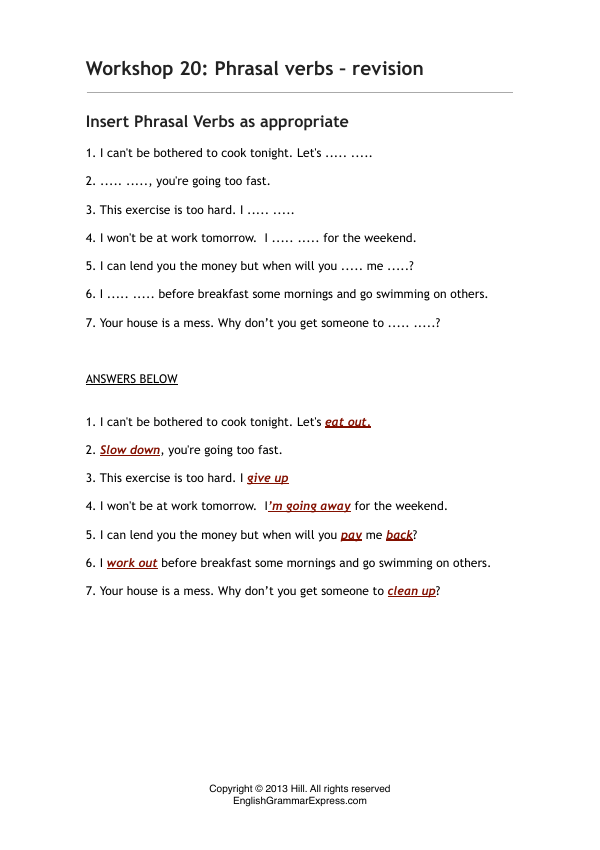
Here is the PDF view to download and as you can see it has all the pictures and examples so that you can test yourself.
Join me in Part 2 for the practice exercises, where I'll test your knowledge of all 50 phrasal verbs of the last two lessons.
Part 3
Try the video exercise
Use the second video exercise to recall the phrasal verbs with up, down, away, back and at.